
- Work
-
Services
- Web
- Mobility
- Digital Strategy
- Digital Startup
- Digital Marketing
- Multimedia
- Emerging Technologies
-
Technology
- HTML5
- Custom Web Application
- Native Vs Hybrid Vs Cross Platform
- WordPress
- Magento Development Services
- Shopify Development Services
- OpenCart Development Services
- Laravel Development
- ReactJS Development
- Node.js Development
- WooCommerce Development
- ASP.NET Development
- MEAN Stack Development
- MERN Stack Development
- Company
- Contact
-
 Academy
Say Hello+91 9824089098
September 22, 2026
Running a business today can feel like changing a car's tires while it's still moving. Customer expectations keep shifting, competition keeps growing, and the old way of doing things — spreadsheets, manual approvals, endless back-and-forth — just can't keep pace anymore.
If your team feels like it's constantly drowning in repetitive tasks instead of focusing on growth, you're not alone. That's exactly the gap Digital Transformation Services are built to close.
At its core, digital transformation isn't about chasing shiny new tools. It's about rethinking how your business actually works:
- Where is time being wasted?
- Where do errors keep creeping in?
- Where can technology quietly take over the grunt work — so your people can focus on what actually moves the needle?
What Does "Digital Transformation" Really Mean for a Business?
Business Digital Transformation is the process of weaving digital technology into every part of your operations from how you manage inventory to how you serve customers to how you make decisions. It's not a one-time software upgrade. It's a mindset shift, supported by the right Digital Transformation Strategy, that touches people, processes, and platforms together.
Done right, it changes three things almost immediately:
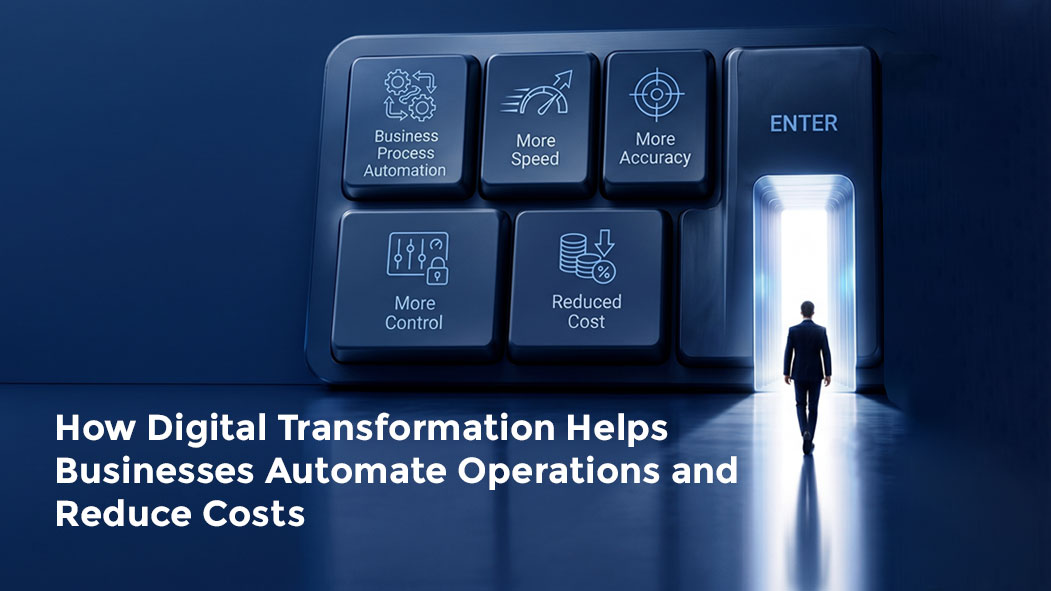
Speed - tasks that used to take days happen in minutes.
Accuracy - fewer manual touchpoints mean fewer costly mistakes.
Visibility - leaders get real-time data instead of end-of-month guesswork.
The Real Connection Between Automation and Cost Reduction
Let's be honest most businesses don't invest in transformation because it sounds trendy. They invest because the math makes sense. Business Process Automation removes the repetitive, rule-based work that eats up hours every single week: data entry, invoice processing, employee onboarding paperwork, inventory updates, follow-up emails, and more.
Here's how that translates into real savings:
Lower labour costs - automation handles repetitive work, freeing employees for higher-value tasks instead of hiring more hands for busywork.
Fewer costly errors - manual data entry mistakes can lead to compliance issues, refunds, or lost customers. Automated workflows drastically cut that risk.
Faster turnaround - the quicker you move, the less it costs to deliver whether that's fulfilling an order or resolving a support ticket.
Smarter resource allocation - with routine tasks automated, teams can be redeployed to strategy, innovation, and customer relationships.
This is where Digital Transformation Solutions go beyond just "installing software" the right solution is designed around your specific bottlenecks, not a generic template.
Where Businesses See the Biggest Impact
While every industry has its own quirks, a few areas consistently see the fastest returns:
Customer Experience - Chatbots, self-service portals, and personalized digital touchpoints reduce support costs while actually improving customer satisfaction.
Operations & Supply Chain - Automated tracking, smart inventory systems, and integrated dashboards eliminate the guesswork (and the spreadsheets held together with hope).
Finance & HR - Automated invoicing, payroll, and approval workflows cut down administrative overhead dramatically.
Marketing & Sales - CRM automation and data-driven campaigns mean your team spends less time chasing leads manually and more time closing them.
This is exactly why Digital Business Solutions are no longer optional add-ons they're becoming the backbone of how competitive companies operate.
A Real Example: Digital Transformation for a Local Home Services Business
Digital transformation isn't just for large corporations, it can make an enormous difference for local, service-based businesses too. Take Shades N Shutters, a family-owned blinds and shutters business based in Rockingham, WA, as an example.
Webmantra worked with Shades N Shutters to strengthen their digital presence building a clean, user-friendly website designed to make it easy for customers to request a free measure and quote, learn about their services, and get in touch quickly. For a business that thrives on fast response times and local trust, having a well-structured digital front door means fewer missed inquiries, faster customer engagement, and a more professional brand presence online all without adding extra administrative burden to the team.
It's a great example of how Digital Transformation Services aren't only about massive enterprise systems sometimes, the biggest impact comes from giving a growing local business the right digital foundation to operate smoothly and scale with confidence.
Building a Strategy That Actually Works
A lot of digital transformation initiatives fail not because the technology is bad, but because there was no clear strategy behind it. A strong Digital Transformation Strategy should always start with a simple question: what specific problem are we solving?
From there, a practical roadmap usually includes:
- Auditing current processes to identify inefficiencies
- Prioritizing quick wins alongside long-term goals
- Choosing scalable tools that integrate with existing systems
- Training teams so adoption doesn't stall out
- Measuring results and refining continuously
This is where working with experienced Business Automation Services providers makes a real difference, they've already seen what works (and what doesn't) across industries, so you're not reinventing the wheel or learning expensive lessons the hard way.
Whether you're looking to automate internal workflows, modernize your digital presence, or build a long-term transformation roadmap, our services are designed to meet you exactly where your business is today and scale with you from there.
Ready to Transform?
Digital transformation isn't about replacing people with machines it's about giving your people the tools to work smarter, not harder. Businesses that embrace automation today aren't just cutting costs; they're building the agility to handle whatever comes next.
If your business is still relying on manual processes that eat up time and money, now is the moment to explore what the right technology partner can do for you.
Frequently Asked Questions
Q1: What is the main benefit of digital transformation for small businesses? The biggest benefit is efficiency small businesses can automate repetitive tasks, reduce human error, and free up limited staff time to focus on growth instead of admin work.
Q2: How does business process automation actually reduce costs? It reduces the need for manual labour on repetitive tasks, minimizes costly errors, speeds up turnaround times, and allows teams to be redeployed to higher-value work.
Q3: Is digital transformation only about adopting new software? No. It's a broader strategy involving people, processes, and technology working together new tools are only effective when paired with the right workflows and training.
Q4: How long does a digital transformation strategy take to show results? It varies by business size and complexity, but many companies see measurable improvements like reduced processing time or lower operational costs within the first few months of implementation.
Q5: How can Webmantra help my business with digital transformation? Webmantra offers end-to-end digital transformation services, including web design, mobile app development, digital strategy, digital marketing, and emerging technology solutions all tailored to your business goals.