
- Work
-
Services
- Web
- Mobility
- Digital Strategy
- Digital Startup
- Digital Marketing
- Multimedia
- Emerging Technologies
-
Technology
- HTML5
- Custom Web Application
- Native Vs Hybrid Vs Cross Platform
- WordPress
- Magento Development Services
- Shopify Development Services
- OpenCart Development Services
- Laravel Development
- ReactJS Development
- Node.js Development
- WooCommerce Development
- ASP.NET Development
- MEAN Stack Development
- MERN Stack Development
- Company
- Contact
-
 Academy
Say Hello+91 9824089098
September 26, 2026
For many small and boutique hotels and motels across the US, the front desk is still powered by a combination of Excel sheets, paper registers, notebooks, computer notepads, phone calls and staff memory.
It may work when the property is small. But as guest expectations, compliance requirements, staff turnover and operational complexity increase, these manual processes can become costly—and sometimes risky.
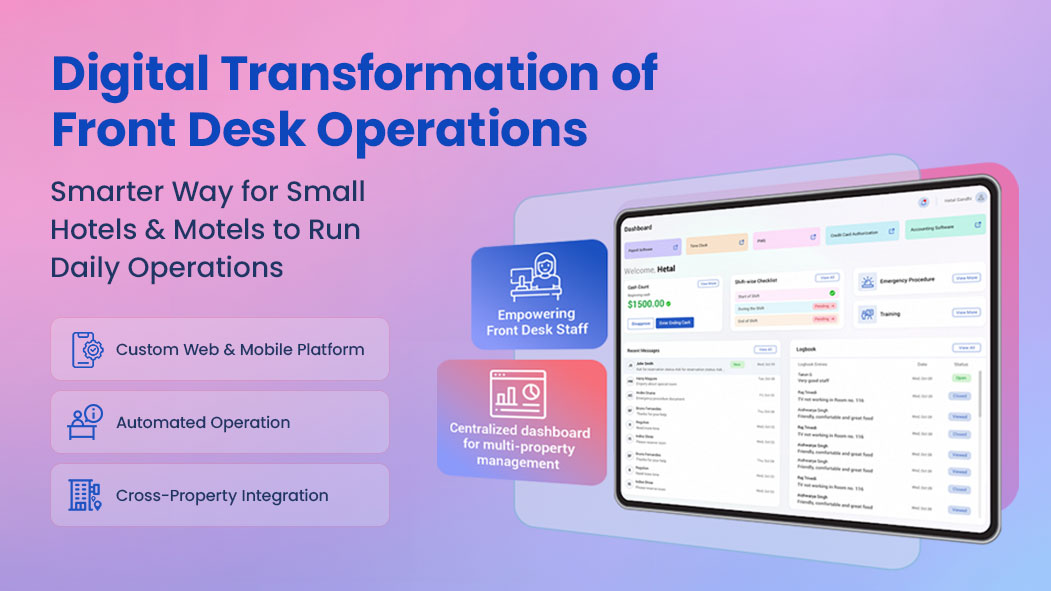
Digital transformation of front desk operations does not necessarily mean replacing your entire Property Management System (PMS). It can start with something much simpler: creating one digital operational layer that connects front desk staff, management, maintenance, cash handling, guest requests, training, incidents and shift handovers.
Here is what that can look like in a real hotel.
1. Every Shift Starts, Runs and Ends With Accountability
A front desk executive may begin a shift by checking arrivals, pending guest requests, cash, messages and maintenance issues. During the shift, new requests and incidents appear. At the end, the employee needs to hand over important information to the next person.
The problem? Much of this may exist across notebooks, Excel files and verbal communication.
With a digital front desk shift management system, employees can complete structured beginning-, during- and end-of-shift checklists. Managers can see what was completed, what remains pending and who completed it.
Small change, big difference: Instead of asking, “Did the previous shift check this?”, management has a digital record.
2. Compliance: When “We Fixed It” Isn't Enough
Imagine a guest falls because a restroom toilet seat cover was damaged. The hotel repairs it immediately. Months later, a legal claim arises.
The management remembers the repair—but there is no dated record, photograph, responsible employee or maintenance history proving when and how it was fixed.
A digital incident reporting and maintenance logging system can connect the incident, maintenance request, action taken, completion status and responsible staff member.
The lesson: In hospitality, fixing a problem is important. Being able to demonstrate that it was identified, addressed and documented is equally important.
3. Emergency Training Shouldn't Live in a Booklet
A fire, medical emergency or security incident is not the time for a front desk employee to search through a manual.
A digital training and emergency procedures module can make critical information searchable and accessible from the front desk. Employees can also be required to review emergency procedures and answer questions during their first login.
This turns training from a once-a-year activity into an operational resource that staff can access when they need it.
4. Make Every Dollar Accountable
Suppose the morning shift starts with $500. The evening shift receives cash, makes refunds and processes payments. At handover, the physical cash does not match the expected amount.
With manual cash counting, identifying where the discrepancy occurred can be difficult.
A digital cash counter log can record denominations, calculate totals and associate cash with start- and end-of-shift processes.
This creates a clearer audit trail and reduces the opportunity for unnoticed errors, loss or misuse.
5. Turn Maintenance Complaints Into Trackable Work Orders
A guest reports that the lights in Room 214 aren't working. The front desk writes it in a notebook or computer notepad and tells maintenance.
But was it fixed? When? By whom? Is another room still waiting?
With digital maintenance logging, front desk staff can submit a request for a room or exterior area, while management and maintenance can update its status as new, in progress or completed.
The front desk sees the latest status instead of relying on memory or phone calls.
6. Guest Requests Should Never Disappear in a Notebook
“Extra towels for Room 108.”
“Wake-up call at 6 AM.”
“Airport information requested.”
When requests are written on paper, they can be missed during shift changes.
A digital general log, messaging and request-tracking workflow creates continuity between employees. The next shift can see what was requested, what was completed and what still needs attention.
Better handovers mean fewer forgotten requests and a better guest experience.
7. Protect Sensitive Credit Card Information
Keeping credit card authorization forms openly at the front desk—or storing card information in Excel or notepad files—creates unnecessary security and privacy risks.
Instead, a digital credit card authorization workflow can send the customer a secure, unique link to submit the required information, while the hotel tracks authorization status through the system.
The objective is simple: reduce unnecessary exposure of sensitive payment information.
What Can a Digital Front Desk Software Include?
A modern front desk operations platform can bring multiple daily processes into one dashboard:
- Shift Management: Start, during- and end-of-shift questionnaires with accountability.
- Cash Counter: Digital denomination tracking and shift reconciliation.
- Time Clock & Timesheet: Punch-in/out and employee time records.
- PMS Integration: Connect front desk operations with the property's existing PMS.
- Training & Emergency Procedures: Searchable training material and emergency instructions.
- Incident Reporting: Digitally record incidents for management review.
- Maintenance Management: Create, track and close room and property maintenance requests.
- Messaging: Maintain communication between management and front desk teams.
- General Logs: Maintain digital shift-to-shift communication.
- Key & Lost-and-Found Logs: Track key movement and found property.
- Inventory: View and update stock and export inventory records.
- Password Vault: Provide controlled access to approved operational credentials and URLs.
- Dashboard Alerts: Push important emergency or administrative alerts.
- HR Documents: Give employees access to relevant HR information and documents.
The Bottom Line: From Front Desk “Memory” to Digital Accountability
Digital transformation doesn't have to mean a complicated technology overhaul.
For a small hotel or motel, it can simply mean replacing scattered notebooks, Excel sheets, verbal instructions and paper forms with one connected front desk operations platform.
The result is greater visibility, stronger shift accountability, faster communication, better documentation, easier training and more consistent guest service.
Your front desk should not depend on who remembers what happened yesterday. It should have a digital record of what happened, what needs attention and who is responsible for the next step.
That is the practical value of digital transformation for modern small and boutique hotels.
Frequently Asked Questions
1. Do small hotels really need front desk digital transformation?
Yes. Even smaller properties can benefit from digital records for shifts, cash, maintenance, incidents, guest requests and employee training. The goal is not technology for technology's sake—it is reducing operational gaps.
2. Does this replace our existing PMS?
Not necessarily. A front desk operations platform can work alongside an existing Property Management System (PMS) and focus on operational workflows that may not be covered by the PMS.
3. Can front desk employees use it without extensive technical training?
Yes. The system should be designed around simple dashboards, forms, checklists, alerts and searchable information so employees can use it during normal front desk operations.
4. How can digital records help with compliance?
Digital records can provide timestamps, user activity, maintenance status, incident details and other documentation. However, specific legal and regulatory requirements vary, so hotels should also consult their legal/compliance advisors.
5. Can digital front desk software improve guest service?
Yes. When guest requests, maintenance issues and shift handovers are tracked digitally, employees are less dependent on memory and verbal communication, reducing the chance of requests being forgotten.
6. Where should a small hotel start?
Start with the processes that create the most operational risk or consume the most staff time—typically shift management, cash reconciliation, maintenance, guest requests, incident reporting and emergency procedures. These can then expand into a broader digital transformation roadmap.